High security · Clarington
Safe Opening & Combination Change
The pharmacy's drop safe has a keypad that finally lost power for good, and the little override key that was supposed to live behind the counter cannot be found anywhere.
Safe Opening & Combination Change
In plain words
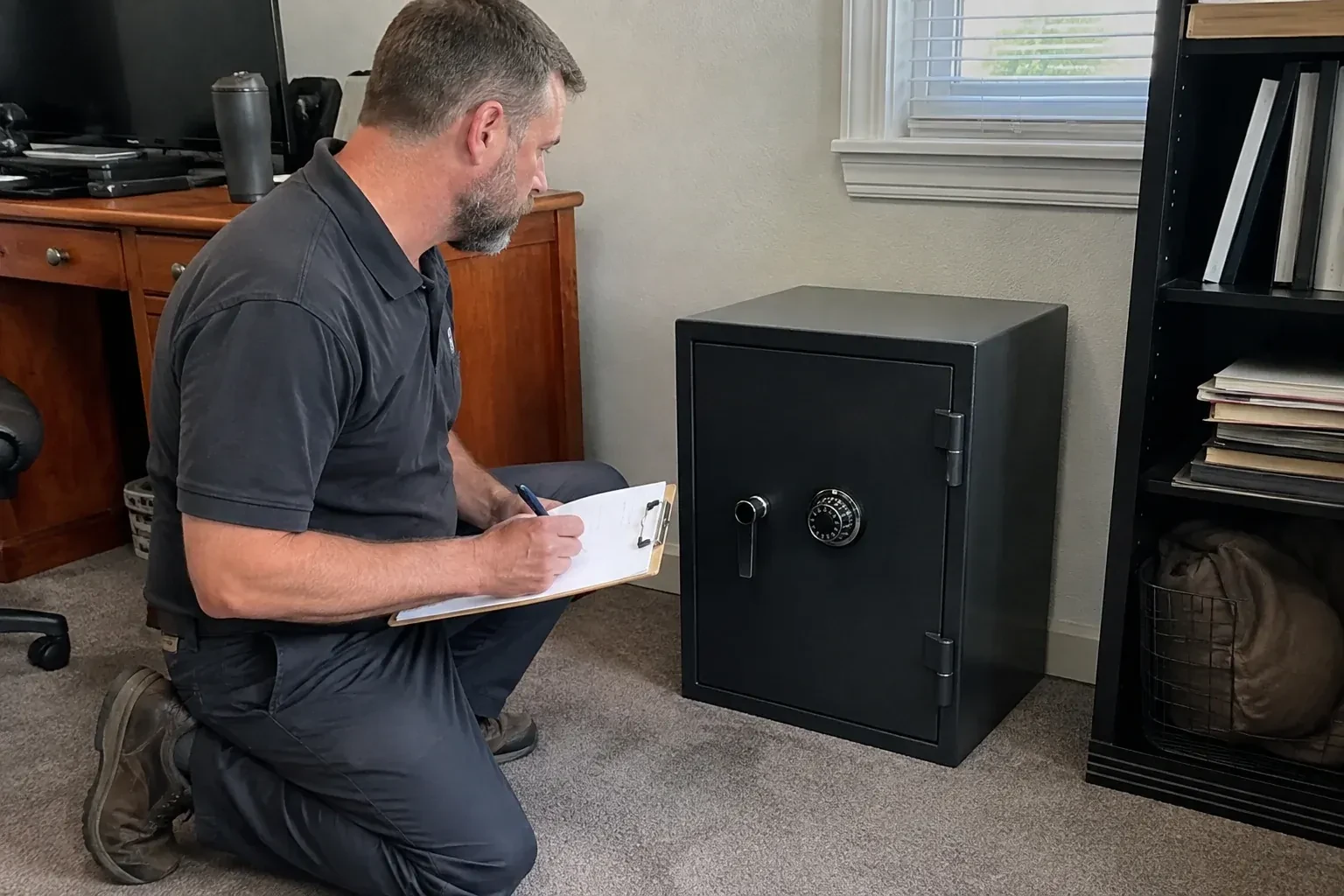
Safe opening favours the gentlest method that fits the particular safe and lock, with drilling kept as a later option rather than a first resort. Manipulation and decoding are tried first for a mechanical dial, and a manufacturer reset or override path where one exists for an electronic keypad. Where those routes are unavailable or exhausted, drilling enters the conversation, aimed at a point the maker's own service literature marks as reachable and repairable. Most safes that still have their original lock in reasonable condition never reach that last rung at all.
How the visit goesPry marks circle the dial after an overnight break-in attempt, and the safe now refuses every number that used to open it, as if something inside has locked itself down.
Clarington
How the visit goes
Mechanical dial or electronic keypad?
The two lock families are opened in entirely different ways, so telling them apart comes early. A mechanical dial relies on a wheel pack turned into alignment by hand, reading resistance and feel rather than any battery or circuit. An electronic keypad instead depends on a stored code and a power source; some models add a reset or override sequence, though many need that connection made at the lock body inside the container rather than from outside. Some commercial safes carry both, a keypad for daily use with a mechanical dial as a backup, and each half is assessed on its own terms. Confusing the two wastes time trying an approach the lock was never built to respond to.
Working a mechanical dial
A dial lock is read through the spindle rather than forced through it. The locksmith applies light, even tension and turns the dial slowly, feeling for the small changes in resistance that mark each wheel of the wheel pack falling into place, or uses a decoding tool built for that lock family to read the gate positions directly. Wear matters here: an older, well-used dial often gives clearer feedback than a newer one, while a dial that has drifted out of alignment over years of use may need the wheel pack itself adjusted once the door is open. Nothing about this process involves force on the dial or handle.
A safe that opens the same way every time
The visit finishes with the door cycled several times under the new combination, both open and closed, so the result is proven rather than assumed. The handle is checked for smooth, even movement, and the bolt work is watched to confirm it retracts and extends fully on each attempt. Anything noticed along the way, a stiff dial, a keypad that needs a firmer press, or a hinge that could use attention, is pointed out plainly so nothing is left as a surprise. You are shown the working combination yourself before the locksmith leaves, rather than simply being told that it works.
Safe Opening & Combination Change
In the van
- Manipulation and tension tools
- Spindle and drive cam
- Dial decoding instrument
- Repair plug and patch plate
- Borescope for internal viewing
What affects the quote
Same fees day, night or weekend
1Whether drilling turns out to be necessary
Manipulation, decoding and manufacturer reset paths are tried first; drilling, a repair plug and any replacement lock only enter the picture once those routes are exhausted.
2Whether model or service records are available
A visible data plate, a purchase receipt or a manual on hand speeds up identifying the exact lock; a safe with none of that takes a few extra minutes to assess on site.
3Where the safe is located
A safe bolted to a floor, built into a wall, or set in a tight closet or basement corner takes more time to work around than one standing freely in an open room.
Safe Opening & Combination Change: questions
Do you need to see proof that I own the safe before opening it?
Yes, and it is meant as a protection rather than a hurdle. For a business, identifying yourself as the owner, manager or an authorized employee is usually enough. For an estate, a secondhand purchase or a change of ownership, a bill of sale, transfer document or executor's paperwork fills the same role. This step protects whoever actually has a claim on what is inside the safe, which includes you.
Can a mechanical dial safe be opened without drilling it?
Most of the time, yes. Manipulation reads the wheel pack through the dial by feel, and decoding tools built for a specific lock family read the gate positions directly, both without any lasting effect on the lock. Whether either works depends on the lock's own security rating and condition, since a high-security Group 1 lock resists these methods far longer than an older Group 2 one, but drilling is only used once both routes are ruled out.
Will opening my safe damage it?
In most cases the lock and case are left intact, since manipulation, decoding and manufacturer reset paths all work the mechanism the way the original combination would. Drilling is kept for cases where the gentler routes are unavailable or exhausted, aimed at one small point the manufacturer marks as repairable, and patched before the visit ends; a skilled technician aims to leave the rest of the body, hinges and finish unaffected, though the outcome and any effect on the safe's rated protection level depends on its construction.
High Security Locks
Safe Opening & Combination Change near you
Below is the full menu of lock and key work available in Clarington, written for people who are not locksmiths. Each entry says what the service is, when it makes sense, and roughly how a visit unfolds, so you can arrive at the door already knowing what the technician is going to do and why.